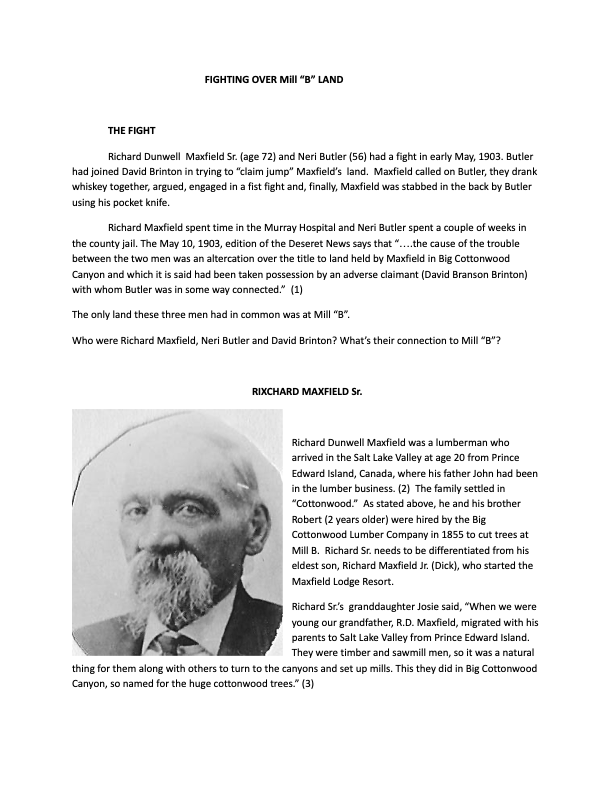
Site 12 – Mill B
Location: Near the present-day site of Mill B South Trailhead
Date: 1855 to about 1885
Significance: One of the early sawmills in Big Cottonwood Canyon. Hiking access to Lake Blanche, Florence, Lillian, and the Sundial Peak.
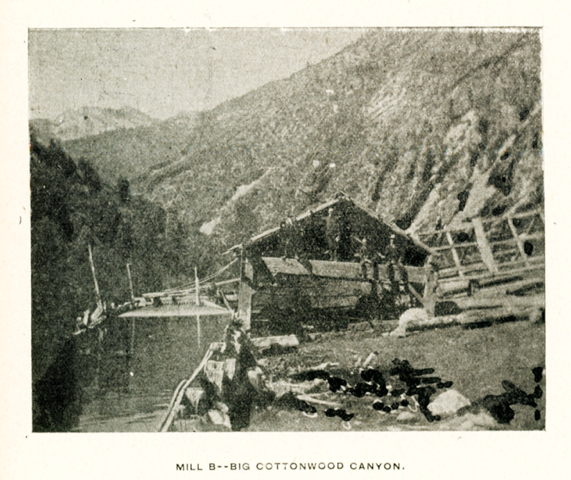
Photo Title: Mill B — Big Cottonwood Canyon. View looking down the canyon. To the left is the manmade pond (formed from the creek), where water could be controlled to turn the wheel and power the saw. Note the two men standing and two men sitting on the roof beam. To the right of the building is a drying rack for lumber. Logs and lumber are piled around the site. [1]
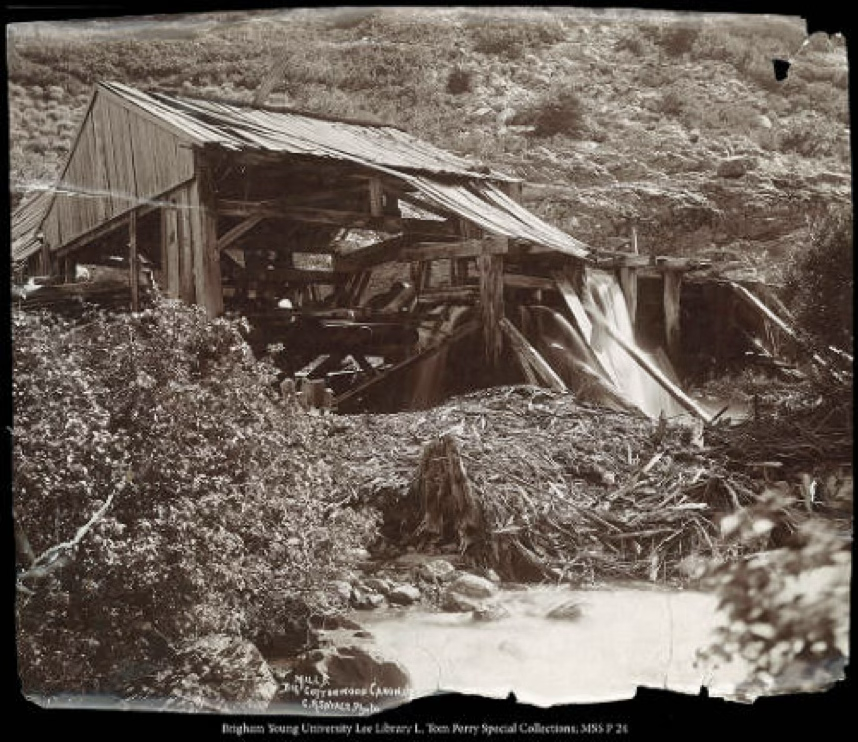
Photo Title: Mill B — Big Cottonwood Canyon, UT. C.R. Savage, Photo. (ca. 1869) Looking up the canyon from the apex of the lower turn of the present-day S-curve. In the bottom of the photo, there is a manmade pond (formed from the creek) that could be controlled to turn the wheel, which powered the saw. [2]
The era of the water-powered lumber mill in the canyon marked the beginning of Salt Lake City’s rapid growth, and the demise of the mainly untouched canyon. Lumber mills and their infrastructure in Big Cottonwood Canyon (BCC) began out of necessity after the Mormon pioneers’ arrival in 1847. Lumber, used for buildings, fence posts, and fuel, was the second most important resource after water. Ample timber supplies didn’t exist in the valley, but the pioneers found resources in the canyons close to downtown, and eventually began to explore BCC. The Mormon Church managed both the water and timber resources for its flourishing city. Access to BCC timber necessitated that the church forge a path up this canyon that had been deemed “impregnable” [3] during early exploration. Big Cottonwood Canyon, formed by both a glacier and running water, originally had tall, stepped stone walls framing the creek particularly in the lower section. Before extensive road work, parts of the lower canyon contained tight rock walls barely wide enough to allow the creek to pass through. The roads and paths created for logging allowed mountain exploration that eventually brought mining and recreation.
The lumber era in BCC began about 1854, peaked in the 1880’s, and ended in 1904 when the Forest Service assumed control of the canyon. Cutting trees and then moving them to mills for sawing was laborious and dangerous work that required skilled labor. Chutes still exist in the canyon where felled trees were slid down a steep face since this was the easiest way to move an enormous tree. Water-powered sawmills were a tremendous labor-saving device allowing increased lumber production and a standardized size. The mills, some of which were mobile, were named alphabetically in the order of their construction, so they are not in alphabetical order going up the canyon. Mills were also named for their owners rather than letter such as Alva Butler’s Saw Mill which was located at the canyon mouth. In 1892, Utah artist and writer, H.L.A. Culmer reflected on the mills as familiar canyon landmarks writing, “…to designate a given point, one simply says, ‘It is so many miles above or below mill ‘A’, or ‘C’ or ‘F,’ ’ as the case may be.” [4] Lumber from this canyon made downtown buildings rise and also topped roofs with wood shingles. When mining began in the 1870’s, wood from this canyon built mining camps and supported the mining tunnels within the mountains.
Mill B was one of several mills constructed by the Big Cottonwood Lumber Company, organized in 1854 by Mormon Church president, Brigham Young, and 5 other prominent men. [5] Frederick Kesler, now remembered in the name Kesler’s Peak, located Mill B’s site along the creek. Old-growth timber would be taken from Broads Fork, Mill B North Fork, and Mill B South Fork, and all three forks still contain evidence of the logging slides and roads. [6] Mill B, outfitted with a relatively simple sash saw [7] was constructed in 1855. [8] TheDesert News of July 30, 1856 reported, “There is a blacksmith’s shop at the second mill, and at all the mills there are comfortable and commodious log buildings for the accommodation of the workmen and their families.” [9]
Richard D. Maxfield and his brother Robert Q. Maxfield, logging men from Prince Edward Island, Canada, were hired by the Big Cottonwood Lumber Company in 1855 to begin cutting trees at Mill B. While this was the most productive method then, it began the practice of clear-cutting [10] which eventually led to deforestation and avalanches.The Big Cottonwood Lumber Company dissolved around 1862 and ownership of Mill B changed multiple times. The arrival of the railroad to Salt Lake City in January 1870 created a surge in the mining industry and also brought lumber to Salt Lake City. The timber industry in the Salt Lake City area peaked about 1880. By 1894, the Big Cottonwood Power Company held the Mill B title, though the mill had probably not been used for years prior to that. [11]
The sawmill has vanished and now Mill B is known as the Lake Blanche trailhead. Most likely, the first people to visit the lakes and dramatic jagged peak arrived on horseback following logging trails. The first images and descriptions of this hidden glacial valley up at 9,000 feet were created by Utah artists and writers. Regional painters are credited with naming the lakes – painter Harry Squires (1850-1928) named Blanche after an unknown woman, painter and author Alfred Lambourne (1850-1926) named Lillian after his baby, and artist and writer Henry L.A. Culmer (1854-1914) named Florence for his daughter. [12] In 1924, just two years before his death, Alfred Lambourne, officially named Sundial Peak in a ceremony hosted by the Wasatch Mountain Club. [13]
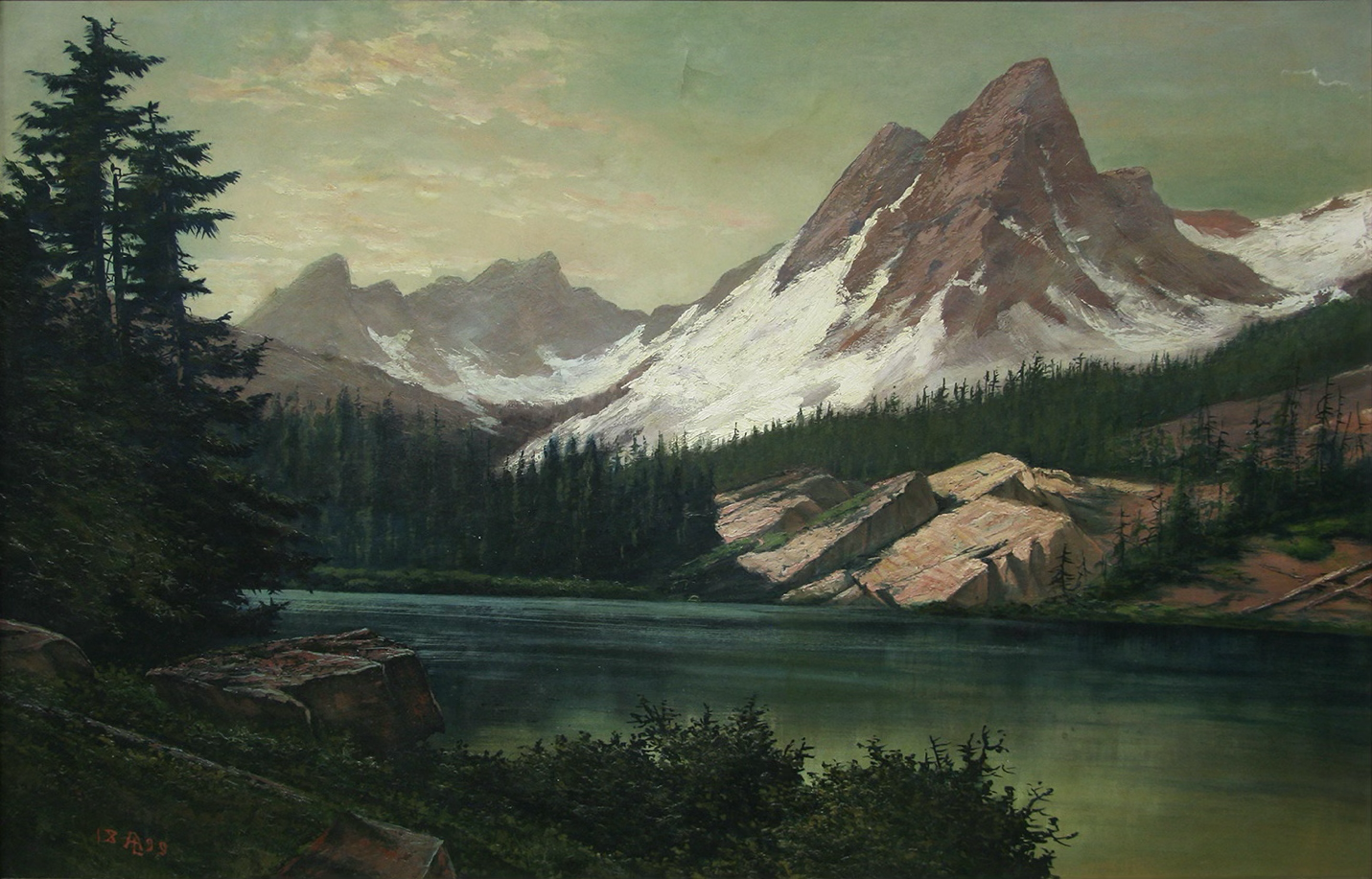
Photo Title: Lake Blanche by Alfred Lambourne, c. 1899. [14]
Interesting Fact: The Wasatch Mountain Club was formed in 1920 to protect and enhance the wild and natural qualities of the State of Utah. Their goal is to continuously improve the quality of the outdoor experience for its members through preservation of wild lands and to preserve access to these lands. Their logo includes an image of Sundial Peak and Lake Blanche. For more information visit: https://www.wasatchmountainclub.org/.

Canyon Stories:
The “Canyon Stories” sections include personal stories, family histories, anecdotes, recollections, excerpts and other information that adds depth and colorful perspectives. Some information might be repetitive, and it has not been as carefully reviewed for accuracy and sources.