11 – Sam McNutt Homestead
Location: Slightly upcanyon from Whipple Fork
Date: Lived here about 1890 - 1912
Significance: Sam acquired land through homesteading and lived alone in the canyon. He was remembered for his fiddle playing, and also hosting and lodging miners and teamsters.
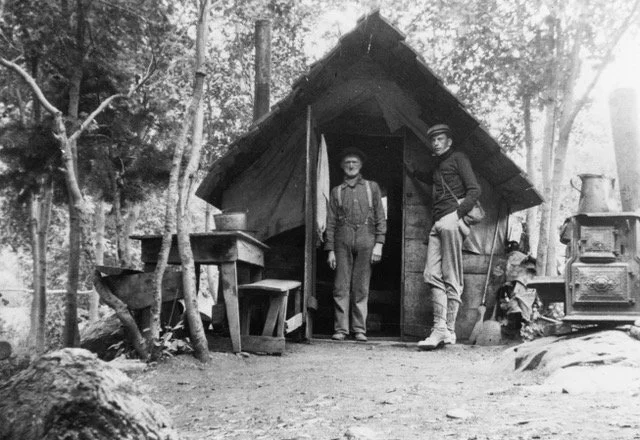
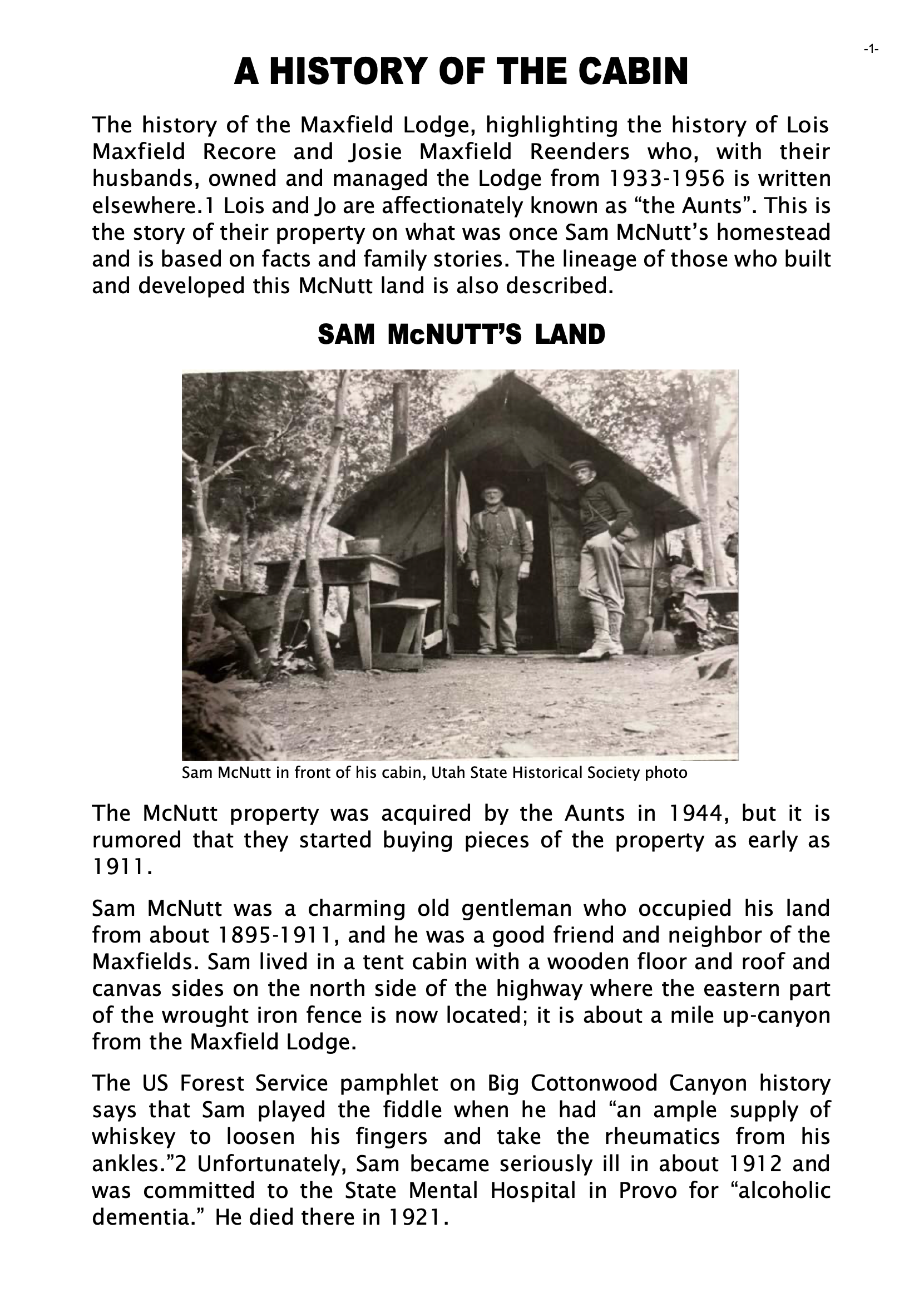
Photo Title: Big Cottonwood Canyon p. 19. (Sam McNutt homestead (Sam McNutt and Billy Schaaf). Between the dam and S turn, Big Cottonwood Canyon, ca. 1880s-1910.[1]
The canyon was home to multi-generational families like the Maxfields, and also newcomers to the Utah territory. Just up canyon from the Maxfield Family lived their neighbor, Sam McNutt. He homesteaded alone and filed mining claims, and around 1895 built a modest cabin at the mouth of Whipple Fork. [2] This was an excellent location along a flat section of the canyon road, close to water and grazing for animals. Asa Bowthorpe recounted, “Many freighters and ore haulers would stop by his place to eat lunch and feed their teams. Old Sam never failed to come out and play a fine tune on his violin for them. As a consequence, Old Sam had enough supplies left for him to get along on. He also appreciated any liquor they might give him. Often travelers caught in the night were welcome to camp with him for the night without charge. Usually, goods were left to pay for his hospitality.“ [3] Two of Sam’s neighbors, the Maxfield sisters remembered, “It fell to our lot to take fresh-baked bread, a quart of milk, or a glass of jelly to him…Whenever father missed a tool he would go up to Sam’s to find it, no hard feelings.” [4] In 1909, Sam received a homestead certificate for his 160 acres of land, allowing him to place mortgages and borrow money. [5] Around 1912, he was taken to the Utah State Mental Hospital in Provo where he died in 1921. [6]
Interesting Fact: The Maxfield sisters painted a vivid memory, “After a few drinks he (Sam) would start to play ‘Pop Goes the Weasel,’ which was one of our favorites. Father would step-dance to an Irish jig.” [7]
Canyon Stories:
The “Canyon Stories” sections include personal stories, family histories, anecdotes, recollections, excerpts and other information that adds depth and colorful perspectives. Some information might be repetitive, and it has not been as carefully reviewed for accuracy and sources.