
Site 8 – The Emergence of Rock Climbing in Salt Lake City
Location: Rocks near Brighton Girl’s Camp and Wasatch Mountain Club Lodge. Pete’s Rock at 5459 Wasatch Blvd (not in the canyon) but nearby at the Mt. Olympus trailhead. Storm Mountain Picnic Area at 5685 East Big Cottonwood Canyon Road which includes The Island. Now, there are climbing routes throughout the canyon.
Date: Beginning about 1939.
Significance: The earliest technical rock climbing in the Salt Lake Valley was in these locations.
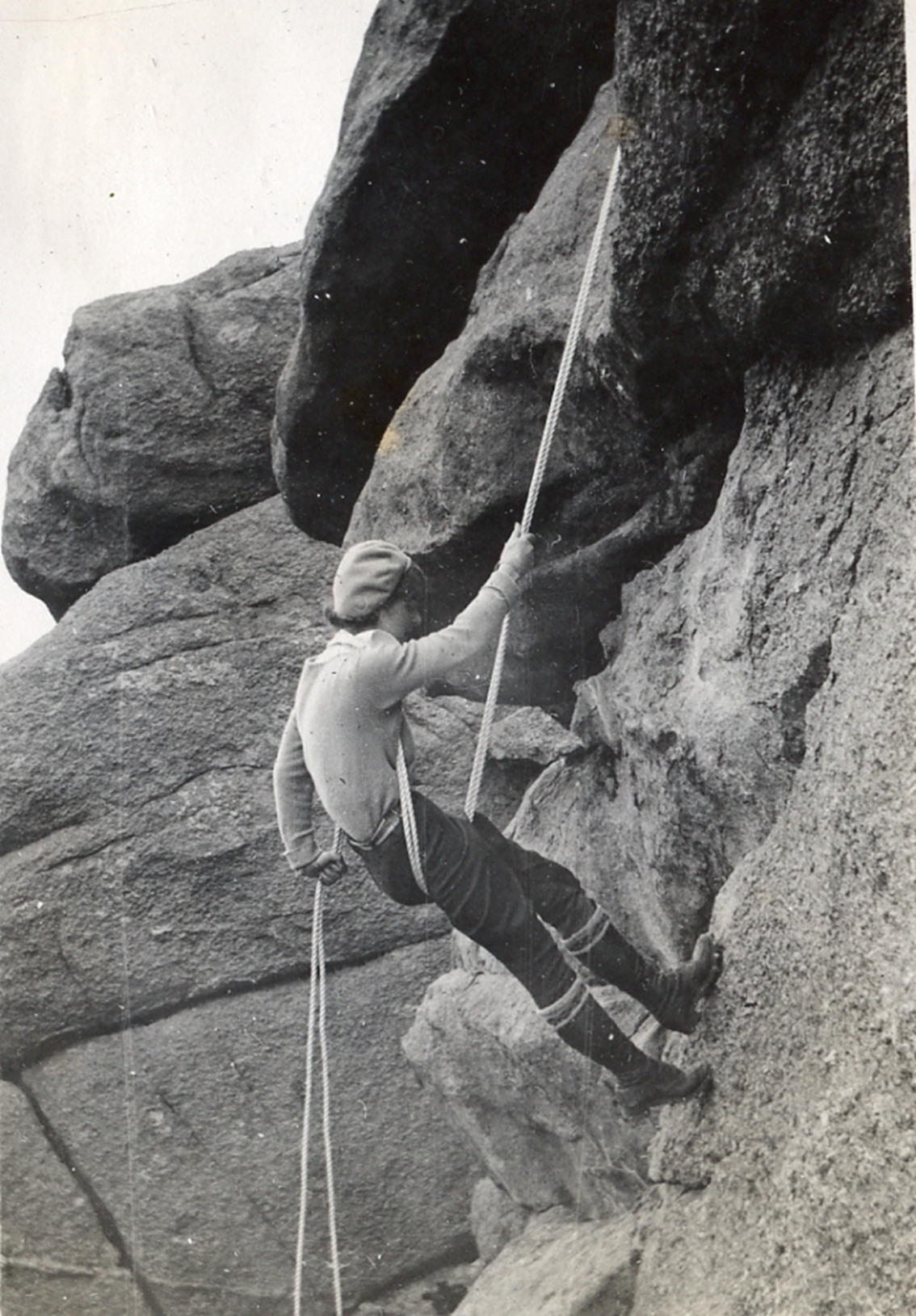
Photo Title: Rock Climbing (location unknown, probably taken in the 1930’s-1940’s). Photo courtesy of Wasatch Mountain Club.
The origins of technical rock climbing in the Salt Lake Valley are inextricably connected to the Wasatch Mountain Club (WMC). Incorporated in 1920 to promote outdoor recreation, this club was the first organized, local hiking group. From 1929 to1937, the WMC volunteers built a monumental lodge at Brighton Resort, founded in 1936. The club lodge was necessary for overnight stays since the canyon trip was so time consuming, especially in the winter. The beautiful lodge, which you can still visit, served as a social gathering spot and base for members embarking on their hiking, climbing and skiing adventures.[1]
The Summer 1939 issue of The Rambler, the WMC’s newsletter, explained the difference between hiking and rock climbing, while announcing the beginning of a “rock squad” headed by member O’Dell Petersen[2], known as “Pete”, and offering lessons to interested members.[3] According to a 1995 interview with Pete, his wife Edith (always called “Pinky”), Harold and Helen Goodro, early rock climbing practice began at the lodge and nearby rocks. In the interview, Pinky explains that for the WMC, rock climbing began when Bert Jensen and another man began showing members early climbing techniques at the WMC lodge and the rocks nearby at the Brighton Girl’s Camp (also called the MIA Lodge) around 1939 or 1940. [4]
Salt Lake newspapers reported as this new sport gained popularity in the early 1940’s. In 1941, the WMC invited Salt Lakers interested in rock climbing to join two practice trips as the club prepared to climb the Grand Teton. They planned to practice in rocks above Brighton and at the rugged terrain of Storm Mountain picnic area.[5] A 1941 Salt Lake Tribune article proclaimed, “Rock climbing, one of America’s newest and fastest growing sports, has come to Utah, and every Saturday afternoon finds a group of Salt Lake enthusiasts clambering among the rocks of Big Cottonwood Canyon.”[6]
Pete’s Rock, named for the WMC member who started the “rock squad” back in 1939, is a well-known climbing landmark near Big Cottonwood Canyon. According to newspaper interviews with Pete, he first spotted the rock in 1943 while returning from a trek in Cottonwood Canyon with his friend Bert Jensen. Pete and Bert thought it unusual that the rock offered such a wide range of technical difficulties so close together.[7] In the 1995 interview, Pinky explained that Pete’s Rock was a convenient climbing location “on the boulevard” because it would be dark by the time people got up to Brighton after work.[8] Pete recalled in a 1972 newspaper article that the WMC started teaching at the rock in 1943, and it continued to be an outdoor classroom for many decades. The June 1952 Rambler announced, “Rock climbing instruction by Harold Goodro at Pete’s Rock on Thursday afternoons at 6 p.m. is something we can’t afford to miss. It’s fun, safe (ropes to hold you up), and a challenge to beginners and advanced. Let’s go climbing.”[9]
The reasons for these early climbing locations were simple: proximity to the city which allowed climbers access, and the nature of the quartzite rock. The rough, jagged quartzite naturally provided sharp hand holds, craggy ridges, cracks and ledges. These first technical climbers relied on hemp ropes, smoothed after dragging them behind a car,[10] while wearing leather-soled boots with hobnails driven into the bottoms for traction.[11] The quartzite provided natural handholds, footholds, and openings to place early climbing hardware. In the early-1960’s, as footwear, rope and gear evolved, climbers began to ascend the smooth granite walls in the adjacent Little Cottonwood Canyon as well as the red sandstone in Moab.
One final thought regarding early rock climbing in Big Cottonwood Canyon is taken from the book, American Rock. Don Mellor writes, ”…but keep in mind that one of the oldest hard routes in America is in Big Cottonwood: Goodro’s Wall, an excellent 5.10c done by Harold Goodro around 1949, a typically unheralded achievement.[12]
Interesting Fact:
In 2018, USA Climbing, the national governing body for the sport, relocated its headquarters from Boulder, CO to Salt Lake City in advance of climbing’s 2020 Olympic debut in Tokyo. The CEO of Climbing USA, Marc Norman, stated in a Salt Lake Tribune article, “With a strong climbing heritage, unrivaled access to indoor and outdoor climbing statewide, and a thriving business community, Salt Lake City is a great choice.”[13]