Site 3 - The Civilian Conservation Corps (CCC)
Camp F-38 (Company 3240)
Location: Approximately 7312 Prospector Drive. The camp sat on several acres near this current address.
Date: 1935 - 1942
Significance: The permanent camp that housed 200 young men from across the United States working on U.S. Forest Service improvement projects during the Depression years.

Photo Title: CCC Company 3340 Camp Big Cottonwood F-35 [1]. The bottom section of the photo shows the main road leading into the canyon (on the far left) in the 1930s and also the entire CCC Camp on the flat area just below the patch of snow on the mountain in the center.
In response to the staggering unemployment during The Great Depression (1929-1939), President Franklin D. Roosevelt created several agencies as part of his “New Deal” program to provide financial relief to Americans. The CCC program began in 1933, and it eventually hired 250,000 unemployed men who lived in 800 camps nationwide while they worked on rural projects. There were CCC camps in every state, however, most of the men were from the eastern U.S. while the majority of the projects were in the west. At that time, few good roads, campgrounds with water and sanitation, or well-marked hiking trails existed on Forest Service land. The CCC Boys, called “Roosevelt’s Tree Army” each earned $30 per month and the government required that $25 be sent home each month to the boy’s dependents [2].
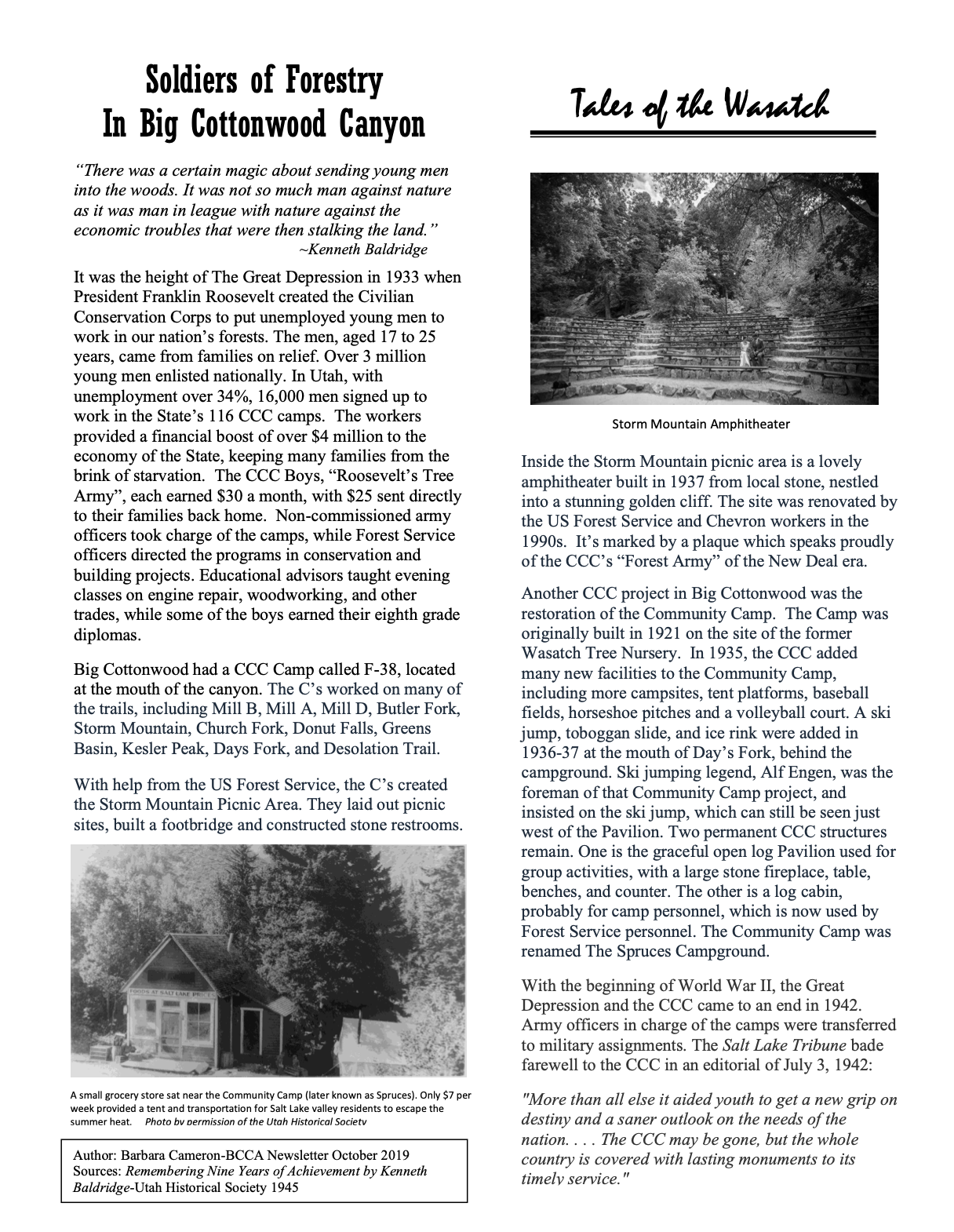
Although nothing remains of CCC Camp F-38 where 200 men lived leading up to World War II, many of their projects are still used in the Big Cottonwood, Little Cottonwood and Millcreek Canyons today. Here are a few examples of what the “C’s” created: Spruces Campground, Storm Mountain Picnic Area, Brighton Loop Road, Redman Campground, Birches and Ledgemere Picnic Areas as well as ski runs and jumps, in addition to planting many of the canyon trees we enjoy today.
Interesting Fact: Ski pioneer, Alf Engen, was camp foreman at this location from the mid to late 1930s. Born in Norway and eventually coming to Utah in 1931, he is remembered for his many contributions to skiing: 16-time U.S. National Ski Jumping Champion, the only person to win a National 4-Way Skiing Championship, his title as "The Father of the Powder Skiing Technique," teaching thousands of people to ski beginning in 1948 while serving as director of the Deseret News Ski School, and helping to develop ski runs at Alta Resort [3]. You can learn more about this extraordinary man at the Alf Engen Ski Museum (3419 Olympic Pkwy, Park City, UT 84098) at the Utah Olympic Park in Park City.

Photo Title: Approximate location of the demolished CCC Camp F-38 [4].
Canyon Stories: The “Canyon Stories” sections include personal stories, family histories, anecdotes, recollections, excerpts and other information that adds depth and colorful perspectives. Some information might be repetitive, and it has not been as carefully reviewed for accuracy and sources.